What I’m doing to fight back against capitalism and protect the environment
“The most common way people give up their power is by thinking they don’t have any.”
It’s hard to not feel helpless and hopeless in our current political system and economy. It can feel easy to throw in the towel, and forget the power you hold as an individual. Because of that I wanted to share all the ways I am personally trying to fight back against capitalism while also protecting the environment. With sharing this, I am by no means judging anyone for how they are participating in capitalism, as we are all forced into it whether we like it or not. But I’m hopeful in sharing that it might help you or others remember that we do have power and can do something, even if it’s small in the grand scheme of things. Therefore, here are the ways I’m fighting back:
Participating in boycotts
I’m aware not everyone is always able to participate in boycotts, and as some have stated online boycotting can even be a privilege in some cases. Maybe it is helpful to pick just one or two causes to stick to that feels doable for you and aligns with your values. But keep in mind, all big corporations care about is money, and they want yours. To me it’s the easiest way to vote and show them what we truly care about, by intentionally choosing where we want our money to go and who to support. Because of this here is who I am actively choosing to boycott:
Starbucks is union busting and potentially in support of the genocide in Gaza. If you’re online you’re probably seeing the active strike that is going on at Starbucks, and I would encourage you to please not cross the picket line and stand in solidarity with the workers!
Target folded and rolled back on their DEI campaign when Trump came into office. I’ve chosen to not shop at Target anymore as of January of this year.
McDonald’s used to be a go to weekly comfort meal for me. Since they’ve been supporting the Israel troops in the ongoing genocide in Gaza as well as rolling back on their DEI initiatives, I’ve stopped eating there and have since started going to Culver’s instead.
Amazon has terrible work conditions and prices small businesses out to become a monopoly. I have been intentional to try to shop small wherever I can.
I think what's tough to remember with boycotts is that it is an ongoing practice. I see a lot of people boycotting for a day, week, or month, but most of these big companies can survive that time frame and have safeguards to bail them out. I don’t plan to shop or support these companies ever again.
Obviously as humans we aren’t perfect and can have slip ups, and sometimes these places can feel like the only options, and as I stated previously sometimes boycotting might be a privilege. However, I think picking one or two that you can actively participate in is helpful. Sometimes the most difficult consequence from boycotting is lack of convenience, but quite frankly I can survive that. The children in Gaza can’t. The workers being exploited and taken advantage of can’t. To me it feels like the least I can do.
Shopping local as much as possible
Because of the boycotts, I’m doing my best to shop local and put my money back into my community as much as possible. It actually hasn’t been as difficult as I was expecting when I initially started the boycotts. There’s definitely more work involved in trying to find products I need, but overall hasn’t been that much of a change from my day to day life.
I think a good starting point can be buying from local bookstores instead of Amazon, or even dare I say Barnes and Noble (sorry). A few that I love in the Indy area are: Golden Hour Books, Tomorrow Bookstore, and Whispering Shelf but there are so many others! If you can’t shop local or in person I’d highly recommend Bookshop.org instead!
Another great option is utilizing your local library and their free apps. I love Libby for my audiobooks. I also use Libby to borrow eBooks and read on my Kindle, instead of paying Amazon for a Kindle Unlimited subscription (which is a rip off in my humble opinion). Some other free apps that the library offers is Hoopla and Kanopy.
Besides bookstores, a few other local shops that I love to frequent is: Rooftop Fruit (for essentials like deodorant and dental care), Salt and Ash (for my bath bombs), and Silver in the City (for fun cutesy little gifts). For coffee shops, some of my favorites are: Rabble Coffee on the near east side, Amberson in Fountain Square, and Never Home Coffee (a new joint inside Natural State Provisions and my personal favorite at the moment).
Thrifting or buying used/borrowing
Going along with the boycotts and shopping local, another thing we can do is purchase second hand or even borrowing items from a neighbor or friend instead of purchasing something we’ll only need or use once. There are even some “Buy Nothing” groups out there that you can join. I think this is a great way to get to know your community and neighbors and engage in the loving act of reciprocity (as Robin Wall Kimmerer discusses in Serviceberry).
Another great way to do this is to hold clothing swaps with your friends where you gather up clothes no longer serving you, and you get together with all your friends and “shop” each others wardrobes! I think that’s such a fun and neat idea that I unfortunately haven’t gotten to partake in yet myself. Lastly for buying used, obviously you can go to some thrift stores such as Goodwill (which I still don’t love but you take some you lose some), but I also love to utilize Depop as well as Poshmark. There’s others out there I don’t really use such as Ebay, Thred Up, and Vinted.
Shopping from ethical and sustainable brands
If for whatever reason you do need to buy new products, because let’s face it, sometimes we do have to, I think it’s important to try to find companies and brands that are offering ethical and sustainable practices. Be careful with this though because there are a lot of brands “green washing” so it does take some digging. I personally use the Good On You app to try to find brands for this as well as Commons. Some brands that I love depending on what you need are Pact and Everlane for everyday wardrobe basics. For fun cute clothes I love Sonderhaus and Damson Madder, however I often try to find these brands pre-loved on Depop. Quince is another one I see a lot, but unfortunately has a poor score on Good On You so I typically avoid them.
Mending clothes and buying better quality items
Another great thing we can do in terms of our societies problem with over consumption is learning how to sew and mend our clothes we already own, as well as buying better quality clothes in general that we can hopefully keep forever and pass down as heirlooms. To do this I’ve been focusing on buying all natural fabrics such as cotton, wool, linen, or silk instead of polyester and acrylic (plastic). With this, price points tends to be a little higher than what you spend on typical fast fashion, but because of this I would consider them investment pieces and ultimately items that will last a lifetime. I think this is another great reason to buy pre-loved as well, and since they are investment pieces we want to learn how to take care of them and mend them when needed. I personally still need to learn how to use a sewing machine and mend my own clothes (I can do it a little), but I have seen some mending classes around the area if you keep your eyes peeled for them!
Making eco-bricks
This is a relatively new practice for me that I learned of and I’m still in the beginning stages of this, so if you have any tips or know anymore about it please share! An eco-brick is essentially stuffing as much plastic as you can into a big plastic container to help avoid having tons of loose plastic on the planet and in our oceans. You can build and create things with your eco-bricks, but I haven’t gotten to that point yet but maybe some day! As for now, I think it’s a great way to keep loose plastic in a contained space trying to create as little environmental impact as possible. With eco-bricking and recycling I’ve noticed that my partner and I have only gone through about one trash bag a week instead of what used to be two, I thought that was pretty cool!
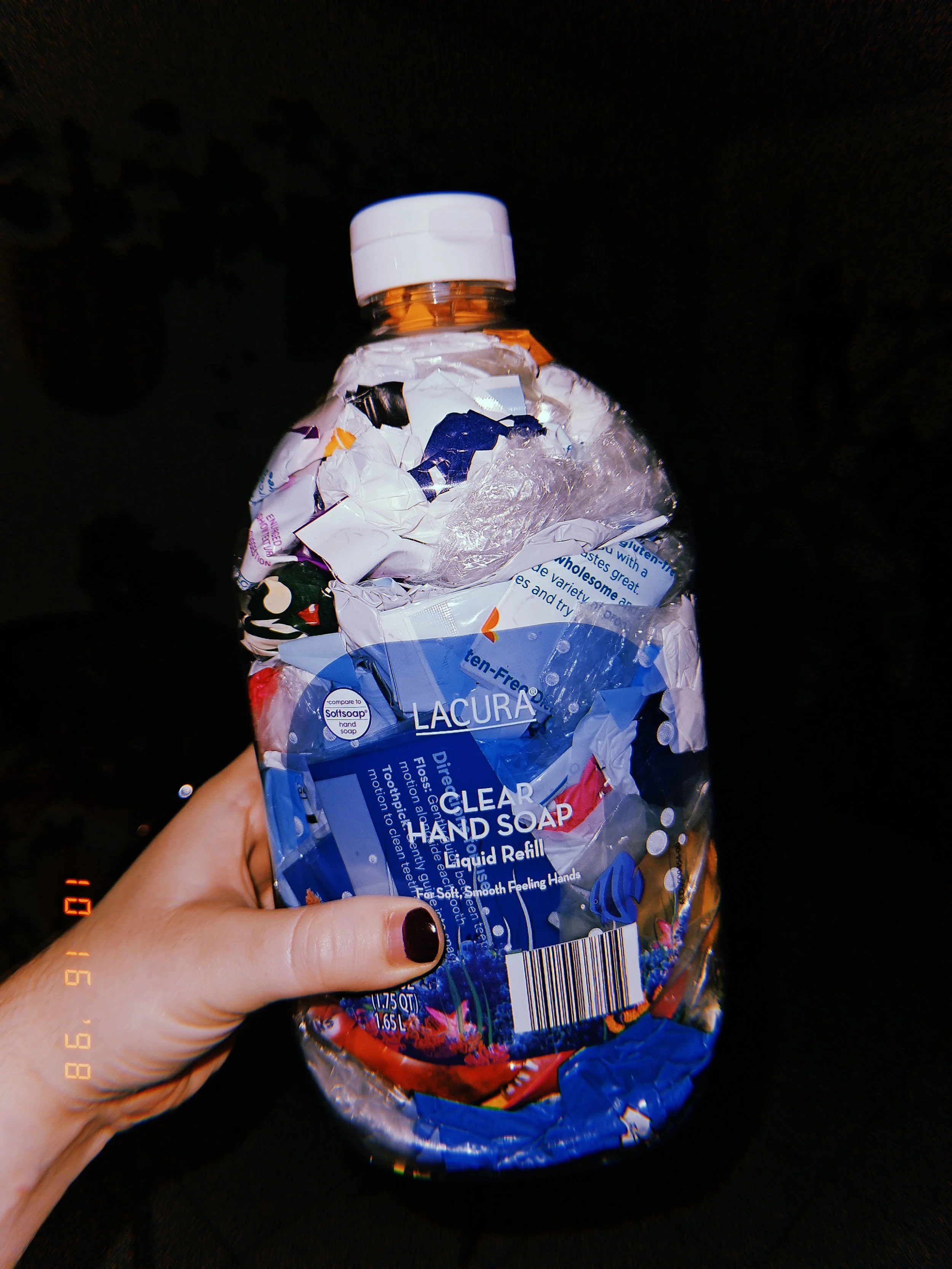
My first eco-brick :)
Planting a native garden
My partner and I just started planting our native garden a couple years ago. I can’t believe how much it has grown and blossomed in its second year already so I’m very excited to see what is to come next spring! The bees and pollinators love it and it’s so amazing to watch the animals and insects enjoy the fruits of our labor. A few things that we have planted is Aster (which blooms in the autumn and is beautiful), Goldenrod, Purple Cone Flower, Black Eyed Susan, Lambs Ear, and a bunch others. It’s beautiful and a great way to give back to the earth. I am looking forward to expanding and hopefully starting a vegetable and fruit garden soon!
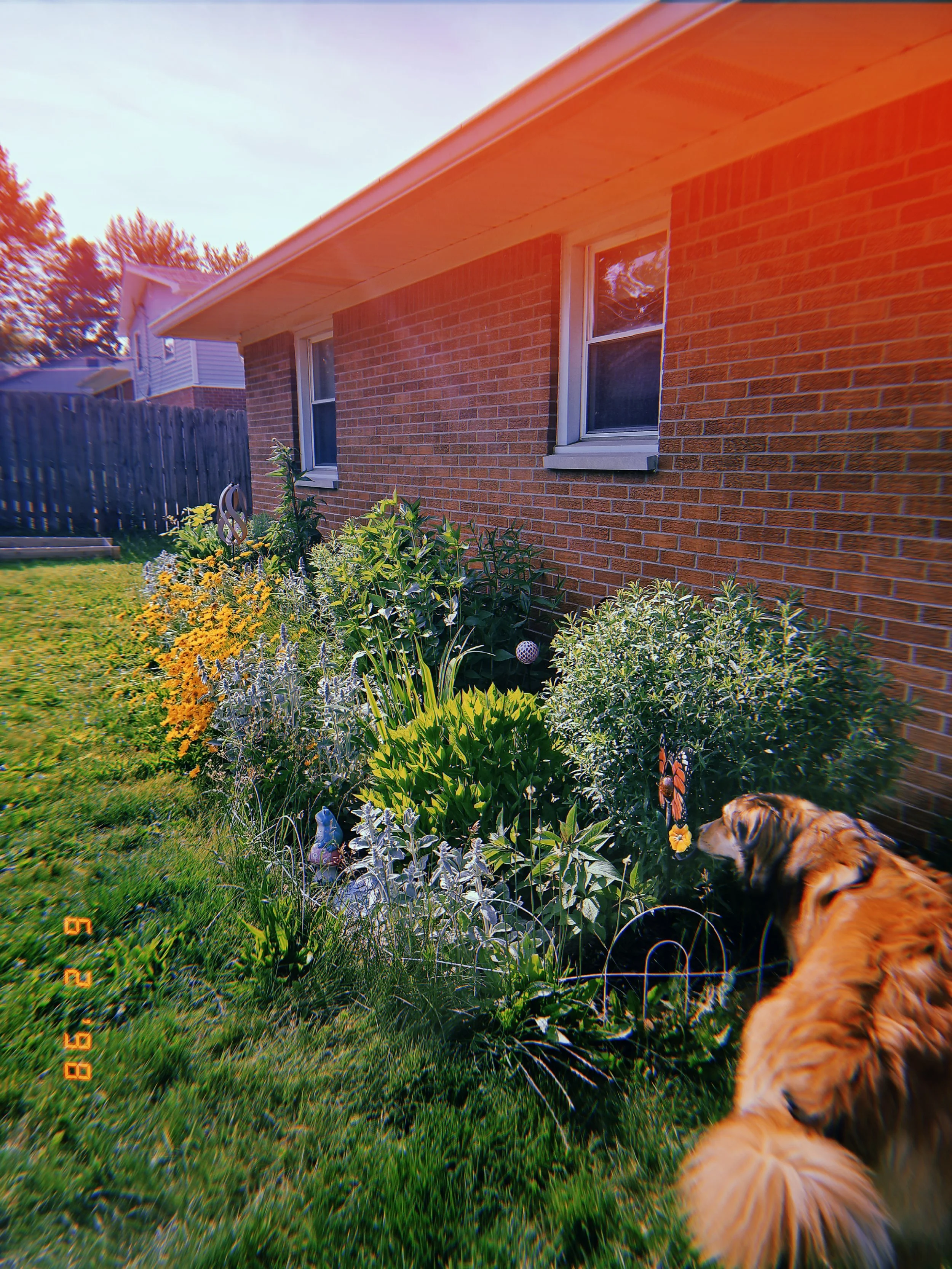
Our lovely little garden, with our dog Lady sniffing about.
Composting
Truthfully, this is probably one I struggle with the most! Composting is a great way to reduce food waste, and it is relatively simple and affordable to do. I just took an old tote box and cut some small holes on top of the lid for aeration and on the side for drainage. You just need to add in a mix of food scraps or “greens” (nitrogen) and cardboard/paper or “browns” (carbon). The reason I have a hard time with this is the simple step of going outside and throwing it in the bin, it is more than I want to do on most days. We have a couple of Tupperware in our freezer that we’ll store food scraps in until we can toss it out, but when that’s full I will put it off FOREVER! But if you can do it, it is a great food and fertilizer for your garden.
Switching from Spotify to Qobuz
This one was more recent with what has come out about the CEO of Spotify investing in military AI as well as them playing ICE recruitment ads (ew). There are a couple of different options to transfer over to, one of them being Apple Music but unfortunately I don’t think Apple is much more ethical than Spotify. I chose to switch to Qobuz and have had good luck with it so far. One thing that I was starting to resent about Spotify beyond the other bullshit was their awful algorithm and only playing the same 10 songs. While Qobuz isn’t perfect and I do miss things about Spotify, I’ve found I have discovered some new artists as well as actually listening to full albums again instead of some random playlist with all the same music over and over again.
These are the main things I am focusing on when it comes to fighting capitalism and I hope helping the environment too. If you have any other tips or tricks or actions that you are taking I’d love to hear from you about them so I can hopefully incorporate them as well. As always, thanks so much for your time and attention in reading my blog post! <3